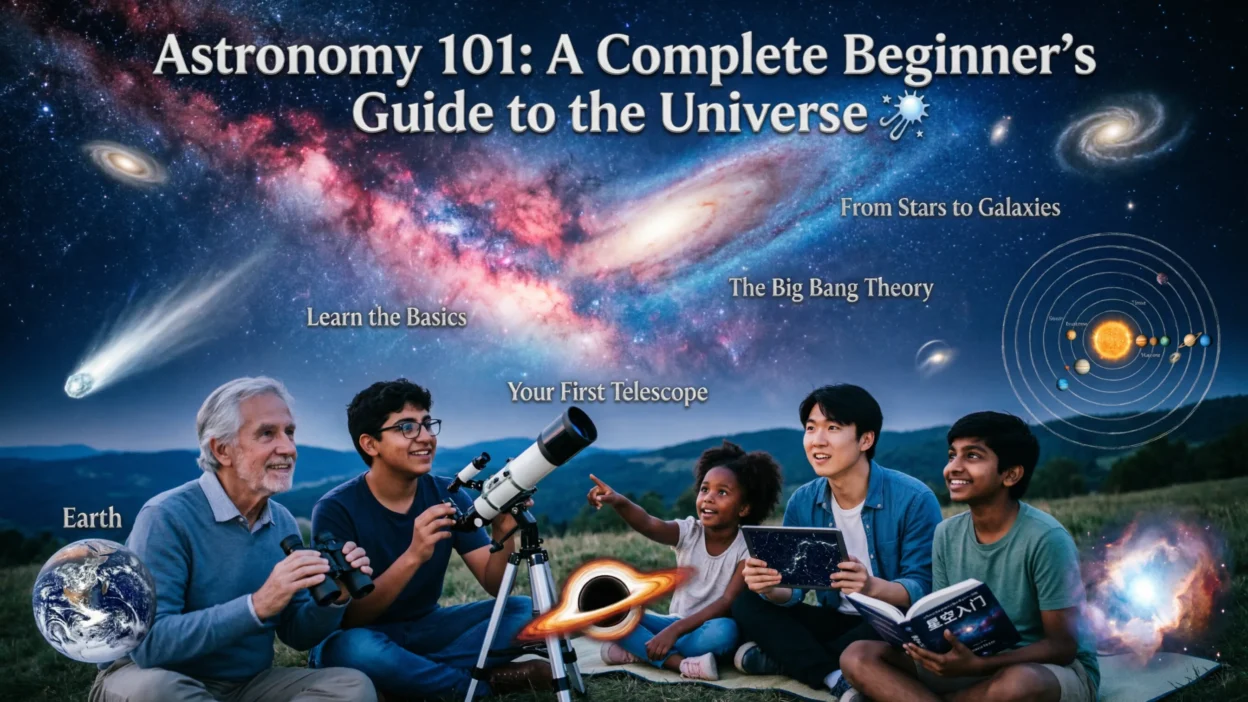
Astronomy 101 is your gateway to understanding the vast, mysterious, and beautiful universe that surrounds us. From the glowing planets and stars above your head to distant galaxies and nebulae, astronomy helps us answer some of humanity’s biggest questions: Where did we come from? What is out there? How does the universe work?
This in-depth guide is designed as a basic astronomy resource for absolute beginners. Whether you are enrolling in an astronomy course, joining an astronomy class online, or simply curious about the night sky, this article will help you learn astronomy step by step—clearly, simply, and confidently.
Astronomy is not just about space—it’s about perspective. It reminds us how small we are, and how amazing that is.
Introduction to Astronomy: Understanding the Universe
Introduction to astronomy begins with a simple idea: studying everything beyond Earth’s atmosphere. This includes stars, planets, moons, comets, asteroids, galaxies, and even the structure of the universe itself.
Astronomy is one of the oldest sciences known to humanity. Ancient civilizations used the sky to:
- Track seasons
- Create calendars
- Navigate oceans
- Develop early science and mathematics
Today, space science 101 has evolved into a modern discipline that combines observation, physics, mathematics, and technology.
What Astronomy Studies
- Celestial objects (stars, planets, moons)
- Space phenomena (eclipses, supernovae, black holes)
- Light years and distances
- The origin and evolution of the universe
Astronomy is not astrology. Astronomy is science, based on evidence, observation, and testing.
Astronomy Fundamentals Every Beginner Must Know
Before diving deeper, let’s build a strong foundation with essential astronomy fundamentals.
Key Concepts in Basic Astronomy
| Concept | Simple Explanation |
|---|---|
| Light Year | Distance light travels in one year (≈ 9.46 trillion km) |
| Orbit | The path an object follows around another |
| Gravity | Force that pulls objects together |
| Rotation | Spinning on an axis |
| Revolution | Movement around another object |
Understanding these basics will help you grasp more advanced ideas in astronomy lessons later.
Solar System Basics: Our Cosmic Neighborhood
The solar system basics are often the first topic in any beginner astronomy course.
What Is the Solar System?
Our solar system formed about 4.6 billion years ago and includes:
- The Sun
- 8 planets
- Over 200 moons
- Millions of asteroids and comets
The Eight Planets Explained Simply
| Planet | Key Feature |
|---|---|
| Mercury | Smallest and fastest planet |
| Venus | Hottest planet |
| Earth | Only known planet with life |
| Mars | Red planet, possible past water |
| Jupiter | Largest planet |
| Saturn | Famous rings |
| Uranus | Tilted sideways |
| Neptune | Strongest winds |
These planets orbit the Sun due to gravity, forming a stable cosmic system.
Planets and Stars: The Building Blocks of Space
Understanding Planets
Planets do not produce their own light. They reflect light from their star.
Key planet features:
- Solid or gas composition
- Clear orbit path
- Nearly round shape
Understanding Stars
Stars do produce light through nuclear fusion.
Facts about stars:
- Made mostly of hydrogen and helium
- Born in nebulae
- Can live billions of years
Our Sun is a medium-sized star, producing enough energy to support life on Earth.
Galaxies and Nebulae: Cities of Stars
When you look deep into space, you are looking at galaxies and nebulae.
What Is a Galaxy?
A galaxy is a massive system of stars, gas, dust, and dark matter.
- Our galaxy contains over 100 billion stars
- Galaxies can be spiral, elliptical, or irregular
What Is a Nebula?
Nebulae are giant clouds of gas and dust.
They are:
- Star nurseries
- Remnants of dying stars
- Colorful and beautiful
Nebulae help astronomers study stellar evolution.
Universe Exploration: How Big Is Everything?
The universe is 13.8 billion years old and still expanding.
Scale of the Universe
- Earth → Solar System → Galaxy → Universe
- Observable universe spans 93 billion light years
Understanding light years and distances helps us comprehend cosmic scale.
When you see stars, you are seeing the past. Light takes time to travel.
Astrophysics for Beginners: The Science Behind the Stars
Astrophysics for beginners focuses on applying physics to space.
It studies:
- Energy
- Motion
- Gravity
- Light
Astrophysics explains how and why things behave in space.
Key Astrophysics Topics
- Nuclear fusion
- Black holes
- Dark matter
- Space-time
Astrophysics is essential for modern astronomy tutorials.
Stellar Evolution: The Life Cycle of Stars
Stars are born, live, and die.
Stages of Stellar Evolution
- Nebula – Birthplace
- Protostar – Early formation
- Main Sequence – Stable life
- Red Giant – Expansion
- White Dwarf / Supernova – Death
Mass determines a star’s fate.
Moon and Sun Study: Earth’s Closest Neighbors
The Moon
- Average distance: 384,400 km
- Controls tides
- Stabilizes Earth’s rotation
The Sun
- Diameter: 1.39 million km
- Surface temperature: 5,500°C
- Produces energy through fusion
Moon and sun study is essential for understanding time, tides, and seasons.
Comets and Asteroids: Ancient Space Travelers
Asteroids
- Mostly rocky
- Found in asteroid belts
- Leftovers from planet formation
Comets
- Made of ice and dust
- Develop glowing tails near the Sun
Both are important celestial objects for studying early solar system history.
Night Sky Observation: Learning by Looking Up
One of the best astronomy activities is simple observation.
Tips for Beginners
- Observe after sunset
- Avoid city lights
- Use star charts or apps
- Start with the Moon and planets
Best Objects to Observe
- Moon craters
- Jupiter’s moons
- Saturn’s rings
- Constellations
Night sky observation builds real-world astronomy skills.
Telescopes for Beginners: Choosing the Right One
You don’t need expensive equipment to start.
Best Beginner Telescopes
| Type | Best For |
|---|---|
| Refractor | Moon & planets |
| Reflector | Deep-sky objects |
| Dobsonian | Easy setup |
A telescope helps you explore space phenomena directly.
Astronomy Lessons and Learning Paths
There are many ways to study astronomy today.
Popular Learning Options
- Self-study books
- Online videos
- Astronomy class online
- Structured astronomy course
What You’ll Learn
- Astronomy fundamentals
- Solar system basics
- Universe structure
- Observational techniques
These astronomy lessons build knowledge gradually.
Astronomy Activities for All Ages
Learning astronomy can be fun.
Engaging Activities
- Star mapping
- Meteor watching
- Building models
- Tracking lunar phases
Hands-on astronomy activities improve understanding and memory.
Why Learn Astronomy?
Learning astronomy offers more than knowledge.
Benefits of Studying Astronomy
- Improves critical thinking
- Encourages curiosity
- Builds scientific literacy
- Inspires wonder
Astronomy teaches us our place in the cosmos.
Astronomy 101 Summary Table
| Topic | Key Takeaway |
|---|---|
| Solar System | Our cosmic home |
| Stars | Energy-producing giants |
| Galaxies | Massive star systems |
| Observation | Learn by watching |
| Astrophysics | Explains the universe |
Final Thoughts: Your Journey into Astronomy 101
Astronomy 101 is not just a subject—it’s a lifelong journey of discovery. With a strong understanding of basic astronomy, astronomy fundamentals, and space science 101, you are now equipped to explore the universe with confidence.
Whether you choose an astronomy class online, follow astronomy tutorials, or simply observe the stars, remember:
Every astronomer—professional or amateur—started by looking up.
Keep exploring. Keep learning. The universe is waiting.

I’m Elijah, the mind behind Punsboxx.com. As a true Pun Master, I love twisting words into clever laughs and serving fresh humor that never goes out of style!