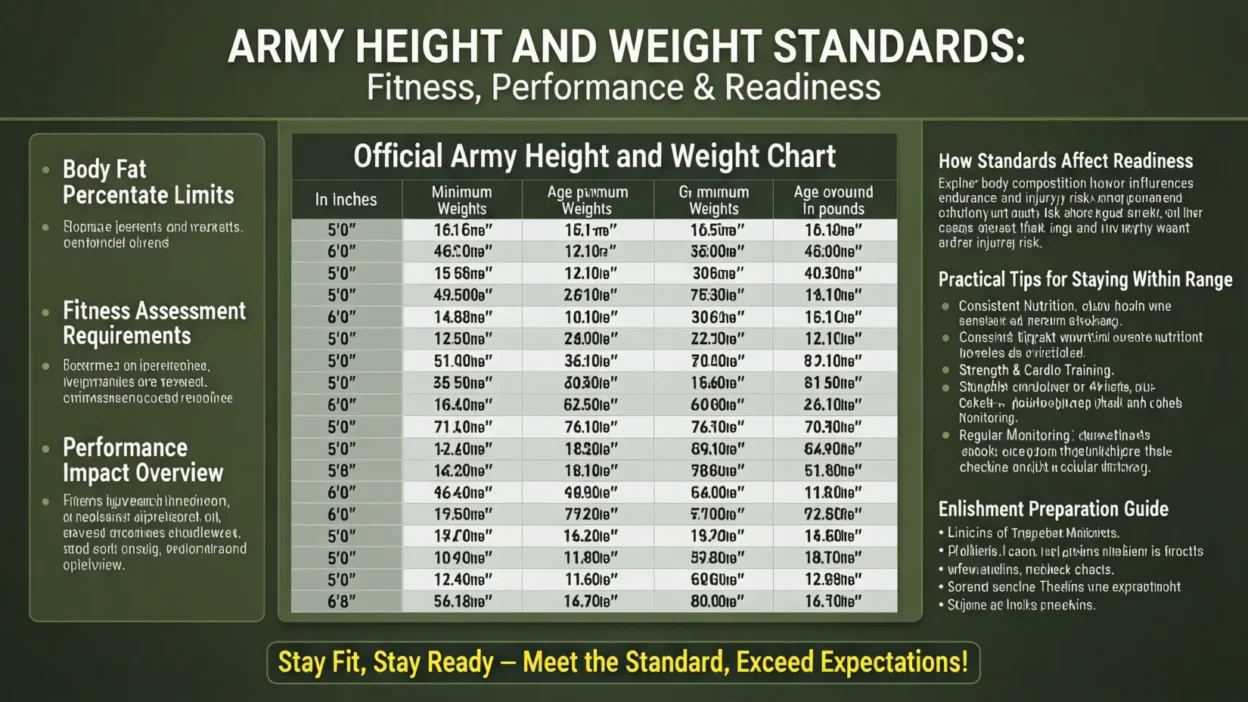
The Army height and weight chart sets the minimum body composition standards every soldier must meet to remain physically ready and deployable. These standards are not about appearance alone they exist to ensure health, performance, and operational effectiveness across the force.
Whether you are preparing for enlistment, attending MEPS, or maintaining compliance on active duty, understanding how Army height and weight requirements work is essential.
The chart serves as an initial screening tool, establishing maximum allowable weight based on height for both men and women.
Soldiers who exceed these limits are not automatically disqualified; instead, they are evaluated under the Army Body Composition Program (ABCP) using body fat standards outlined in AR 600-9. This two-step process allows the Army to distinguish between excess body fat and healthy muscle mass.
In this guide, we’ll break down the Army height and weight chart, body fat standards, tape test rules, and what happens if you exceed the limits so you know exactly where you stand.
What Is the Army Height and Weight Chart?
The Army height and weight chart is an official screening table used to determine whether a soldier meets the Army’s baseline body composition standards. It lists the maximum allowable weight for each height, with separate charts for men and women. These screening weights are age-neutral, meaning the same height and weight limits apply regardless of a soldier’s age.
This chart is governed by Army Regulation (AR) 600-9, which outlines the policies of the Army Body Composition Program (ABCP). Its purpose is not to measure fitness or physical ability, but to identify soldiers who may exceed authorized body fat levels and require further evaluation.
Importantly, failing the height and weight chart does not automatically mean failure of Army standards. Soldiers who exceed the maximum screening weight are given a secondary assessment using the Army tape test, which estimates body fat percentage based on body circumference measurements. Many muscular or athletic soldiers exceed the weight chart but still pass body fat standards.
The height and weight chart is typically used during routine unit weigh-ins, schools, promotions, and reenlistment processing. Understanding how this screening tool works helps soldiers prepare properly and avoid unnecessary administrative actions under the ABCP.
How the Army Height and Weight Screening Process Works
The Army height and weight screening process follows a standardized, two-step evaluation designed to quickly identify whether a soldier meets body composition requirements. The first step is the height and weight screening, where a soldier’s height is measured and their weight is compared against the official Army height and weight chart for their gender.
If a soldier’s weight is at or below the maximum allowable weight for their height, they automatically pass the screening and no further action is required. However, if a soldier exceeds the screening weight, they are not immediately considered noncompliant. Instead, they move to the second step of the process: a body fat assessment.
This secondary evaluation is conducted using the Army tape test, which estimates body fat percentage based on circumference measurements. Only soldiers who fail to meet the authorized body fat standards after this assessment are considered out of compliance with AR 600-9.
Height and weight screenings are commonly conducted during routine unit assessments, prior to schools, promotions, reenlistment, and other administrative actions. Commanders are responsible for ensuring measurements are performed accurately and consistently. Understanding this process helps soldiers avoid confusion and reduces unnecessary stress during weigh-ins, especially for those with higher muscle mass who may exceed screening weight but still meet body fat standards.
Army Height and Weight Chart for Men
The Army height and weight chart for men establishes the maximum allowable screening weight based on height. These limits are used as an initial assessment tool and apply equally to all male soldiers, regardless of age or duty position. The goal is to quickly determine whether a soldier may exceed authorized body fat standards and requires further evaluation.
For male soldiers, heights typically range from 58 to 80 inches, with corresponding maximum weights increasing incrementally as height increases. Shorter soldiers have lower allowable weights, while taller soldiers are permitted higher maximum weights to account for overall body mass. However, the chart does not account for muscle density, bone structure, or athletic build, which is why exceeding the screening weight does not automatically result in failure.
Many physically fit male soldiers—particularly those engaged in strength training—may exceed the weight limit while maintaining a low body fat percentage. In these cases, the Army tape test is used to determine compliance under AR 600-9.
It’s important for male soldiers to view the height and weight chart as a screening mechanism, not a final judgment of fitness. Understanding where you fall on the chart allows you to prepare for weigh-ins, track progress, and avoid unnecessary enrollment in the Army Body Composition Program.
Army Height and Weight Chart for Women
The Army height and weight chart for women sets the maximum screening weight allowed based on height and serves the same screening purpose as the male chart. These standards apply to all female soldiers, regardless of age, rank, or occupational specialty, and are outlined under AR 600-9 as part of the Army Body Composition Program.
Female height standards generally range from 58 to 80 inches, with maximum allowable weights increasing proportionally with height. While the chart accounts for average physiological differences between men and women, it does not consider individual factors such as muscle mass, body composition, or athletic conditioning. As a result, some physically fit female soldiers may exceed the screening weight but still meet body fat standards.
If a female soldier exceeds the maximum weight for her height, she is referred to a body fat assessment using the Army tape test. For women, this includes circumference measurements of the neck, waist, and hips, which are used to estimate body fat percentage. Passing the tape test confirms compliance, even if the screening weight is exceeded.
Understanding the female height and weight chart helps soldiers anticipate screening outcomes and prepare appropriately. Like the male chart, it is a preliminary evaluation tool, not a definitive measure of fitness or readiness.
What Happens If You Exceed Army Height and Weight Standards?
Exceeding the Army height and weight screening standards does not automatically mean a soldier has failed Army requirements. Instead, it triggers a secondary evaluation under the Army Body Composition Program. When a soldier exceeds the maximum allowable weight for their height, they are referred for a body fat assessment to determine whether they meet authorized body fat limits.
If the soldier passes the body fat assessment, no further action is taken, and they are considered compliant with AR 600-9. However, if the soldier fails the body fat standard, they may be formally enrolled in the Army Body Composition Program (ABCP). Enrollment typically includes counseling, nutrition guidance, and a monitored plan to reduce body fat safely.
Soldiers enrolled in the ABCP may also receive a temporary administrative flag, which can restrict promotions, attendance at military schools, favorable actions, and reenlistment options until compliance is restored. Commanders are required to provide soldiers with a reasonable opportunity to meet standards through structured support and periodic reassessments.
Failing to make satisfactory progress or repeatedly failing body composition standards can result in adverse administrative actions, including separation from the Army. Understanding these consequences emphasizes the importance of maintaining compliance and addressing body composition issues early rather than waiting until official weigh-ins.
Army Body Fat Standards Explained
The Army body fat standards determine final compliance with body composition requirements when a soldier exceeds the height and weight screening limits. Unlike the screening chart, body fat standards vary by age and gender, recognizing natural changes in metabolism and body composition over time. These limits are clearly defined in AR 600-9 and are the decisive factor in pass or fail determinations.
For male soldiers, the maximum allowable body fat percentage ranges from 20% to 26%, depending on age. For female soldiers, the allowable range is higher, typically between 30% and 36%, reflecting physiological differences. Soldiers who remain within these limits are considered compliant, even if they exceed the height and weight chart.
Body fat standards exist to balance physical readiness and health, not to penalize muscular or athletic individuals. A soldier with high lean mass may exceed screening weight but still maintain a body fat percentage well below the maximum threshold.
When a soldier exceeds both the screening weight and body fat limits, they are enrolled in the Army Body Composition Program and monitored for progress. Understanding body fat standards is critical because they represent the final authority on compliance. Weight alone does not determine success—the Army’s focus is on maintaining a force that is fit, healthy, and capable of performing demanding missions worldwide.
Army Tape Test Explained Step-by-Step
The Army tape test is the official method used to estimate a soldier’s body fat percentage when they exceed height and weight screening standards. This test relies on circumference-based measurements rather than scale weight, allowing the Army to differentiate between excess body fat and lean muscle mass.
For male soldiers, the tape test measures the circumference of the neck and waist. For female soldiers, measurements are taken at the neck, waist, and hips. Each measurement is conducted multiple times to ensure accuracy, with results averaged according to AR 600-9 guidelines. Soldiers are required to stand upright, relaxed, and in a standardized posture during measurements.
Once measurements are recorded, the Army uses established formulas to convert the circumference values into an estimated body fat percentage. If the calculated percentage falls at or below the maximum allowable limit for the soldier’s age and gender, they pass the body fat assessment.
Although widely used, the tape test has faced criticism for potential inaccuracies, particularly for soldiers with larger necks or atypical body proportions. Despite these concerns, it remains the Army’s authorized method due to its simplicity, consistency, and logistical practicality. Understanding how the tape test works allows soldiers to prepare properly and ensures measurements are conducted fairly and accurately.
Accuracy and Controversy Surrounding the Army Tape Test
The Army tape test has long been a subject of debate due to questions about its accuracy and fairness. Critics argue that circumference-based measurements can overestimate or underestimate body fat, particularly for soldiers with larger necks, narrow waists, or nontraditional body proportions. In some cases, a soldier with higher body fat may pass, while a lean, muscular soldier may fail.
Scientific studies have shown that more advanced methods—such as DEXA scans, Bod Pod analysis, and hydrostatic weighing—provide more precise body fat measurements. However, these methods require specialized equipment, trained personnel, and significant resources, making them impractical for large-scale military use.
The Army continues to use the tape test because it is cost-effective, standardized, and deployable worldwide. To improve fairness, AR 600-9 includes strict guidelines on measurement technique, repetition, and averaging to minimize error and bias. Units are required to ensure trained personnel conduct measurements and follow procedures exactly.
In response to ongoing criticism, the Army has explored alternative body composition assessment methods, including enhanced fitness testing and updated calculation formulas. While discussions continue, the tape test remains the official standard. Understanding both its limitations and purpose helps soldiers navigate the system more effectively and advocate for accurate measurement during evaluations.
Height and Weight Standards by Age: What Changes and What Doesn’t
A common misconception is that the Army height and weight chart changes with age, but this is not the case. The height and weight screening standards are age-neutral, meaning the same maximum allowable weight applies to all soldiers of the same height and gender, regardless of age or rank.
What does change with age are the Army body fat standards. As soldiers grow older, the Army allows a higher maximum body fat percentage to account for natural metabolic changes and shifts in body composition. These age-based adjustments recognize that maintaining extremely low body fat becomes more challenging over time while still ensuring soldiers remain healthy and operationally capable.
For example, younger soldiers are held to stricter body fat limits, while older age groups are given slightly higher allowances. However, these allowances are still closely regulated and enforced under AR 600-9. Exceeding both the age-adjusted body fat standard and the height and weight screening limit results in noncompliance.
Understanding this distinction is critical. Many soldiers incorrectly focus solely on scale weight, when in reality body fat percentage is the determining factor after screening. By maintaining body fat within authorized limits, soldiers of any age can remain compliant—even if they exceed the initial height and weight chart. This reinforces the Army’s emphasis on overall fitness rather than weight alone.
Frequently Asked Questions
What is the maximum weight allowed in the Army?
The maximum allowable weight depends on a soldier’s height and gender. The Army uses an official height and weight chart as a screening tool. Soldiers who exceed this weight are evaluated using body fat standards under AR 600-9.
Can you exceed the Army weight limit and still pass?
Yes. Exceeding the screening weight does not mean failure. Soldiers who exceed the chart can still pass by meeting the authorized body fat percentage through the Army tape test.
Does the Army height and weight chart change every year?
No. The chart does not change annually. Updates only occur when AR 600-9 is revised, which happens infrequently.
Is the Army tape test accurate?
The tape test is a practical estimation method but not the most precise. While it has limitations, it remains the Army’s authorized body fat assessment due to consistency and global applicability.
Are height and weight standards the same for men and women?
No. Men and women have different screening weights and body fat limits to account for physiological differences.
What happens if you fail Army height and weight standards?
Soldiers who fail body fat standards may be enrolled in the Army Body Composition Program and face administrative restrictions until compliance is restored.
Conclusion
The Army height and weight chart plays a critical role in maintaining a fit, healthy, and mission-ready force. While it serves as an initial screening tool, it is only one part of the broader Army Body Composition Program outlined in AR 600-9. Soldiers who understand the difference between screening weight and body fat standards are far better prepared to navigate weigh-ins and avoid unnecessary administrative action.
It’s important to remember that weight alone does not define fitness. Many capable, physically strong soldiers exceed the height and weight chart but remain fully compliant by meeting authorized body fat limits. The Army’s two-step evaluation process exists to account for these differences while still enforcing uniform standards across the force.
Maintaining compliance should be viewed as a long-term commitment, not a short-term fix before an official weigh-in. Consistent training, proper nutrition, and realistic body composition goals are far more effective than crash dieting or last-minute adjustments. Leaders also play a key role by ensuring fair measurements, providing guidance, and supporting soldiers who are working to meet standards.
By understanding how Army height and weight requirements work—and how to meet them—soldiers can protect their careers, improve readiness, and focus on what matters most: mission success.

I’m Luca, the voice behind Punsboxx.com, where I create simple, clever puns to make people smile with everyday humor.