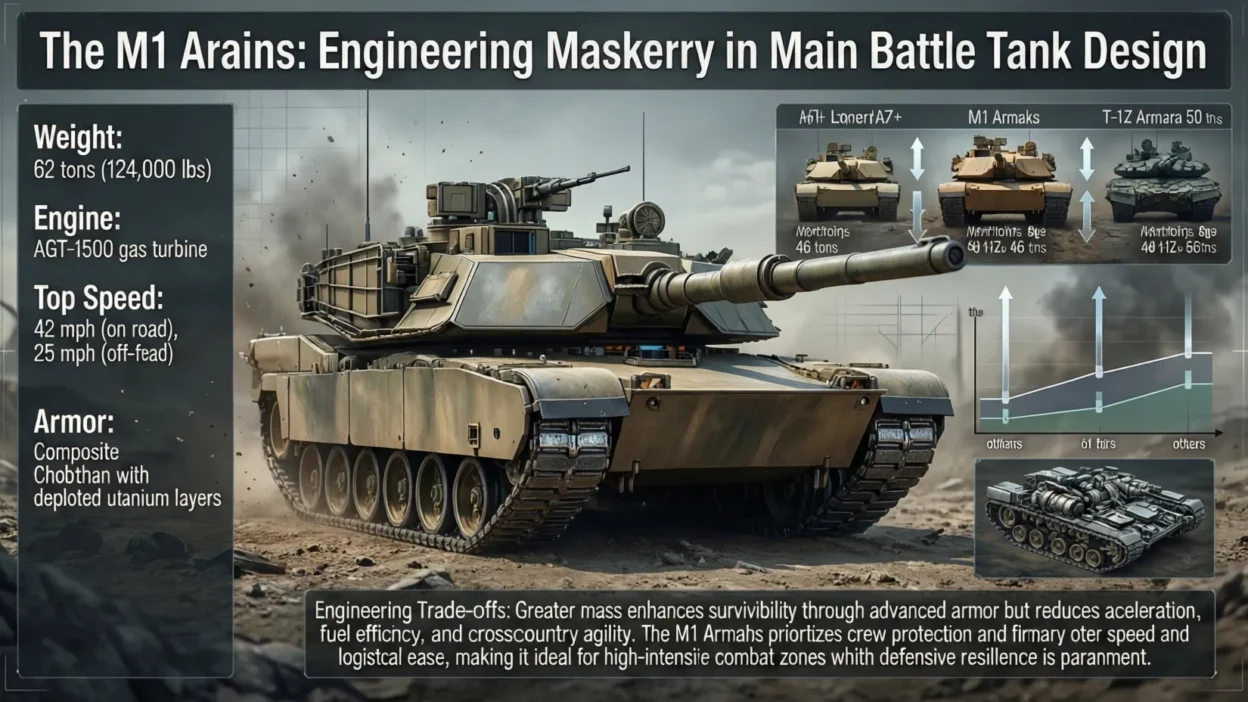
The M1 Abrams tank is a symbol of modern military engineering, combining firepower, armor, and mobility into one formidable package. Since its introduction in the 1980s, it has served as the backbone of the U.S.
Army’s armored forces, earning a reputation for resilience on the battlefield. One question that often intrigues both enthusiasts and casual readers is: how much does an M1 Abrams weigh? The answer is more than a simple numberit reveals the careful balance of armor, weapons, and technology required to create a tank that is both heavily protected and surprisingly maneuverable.
Understanding the weight of the M1 Abrams provides insight into its performance, transport logistics, and tactical advantages. In this article, we’ll explore the weight of different Abrams variants, the factors contributing to its heft, and how it compares to other modern main battle tanks.
General Specifications of the M1 Abrams
The M1 Abrams is a marvel of modern armored vehicle design, combining advanced technology with raw power. Measuring approximately 32 feet in length, 12 feet in width, and 8 feet in height, it is a massive machine, yet designed for battlefield mobility. Its crew consists of four members: a commander, gunner, loader, and driver, each positioned strategically to operate the tank efficiently under combat conditions.
Under the hood, the Abrams is powered by a turbine engine generating around 1,500 horsepower, allowing it to reach top speeds of up to 45 miles per hour on roads and around 30 mph off-road, impressive for a vehicle weighing tens of tons. The tank’s fuel capacity, about 500 gallons, provides a combat range of roughly 265 miles, though fuel consumption increases with terrain difficulty and operational load.
When it comes to weight, the distinction between empty weight and combat weight is crucial. The empty weight without crew, ammunition, or fuel ranges from around 54 to 63 tons, depending on the variant. Combat weight, which includes full ammunition, crew, and fuel, can exceed 70 tons, highlighting the engineering feat required to balance protection, firepower, and mobility. Understanding these specifications lays the foundation for appreciating the tank’s overall weight and battlefield performance.
Weight of Different M1 Abrams Variants
The M1 Abrams has evolved through multiple variants over the decades, each with incremental improvements in armor, electronics, and weaponry resulting in changes to its weight.
The original M1 tank, introduced in the early 1980s, had a combat weight of approximately 60 tons. It featured Chobham composite armor and a 105mm cannon, striking a balance between protection and mobility. The M1A1, introduced later, upgraded to a 120mm smoothbore cannon and improved armor, increasing its combat weight to around 67 tons. This heavier design offered enhanced survivability on the battlefield without significantly compromising speed.
The M1A2, a major modernization, integrated advanced electronics, targeting systems, and reinforced armor, bringing the combat weight to roughly 68–70 tons. Subsequent upgrades, such as the M1A2 SEP v3 and SEP v4, added additional armor packages, communication systems, and defensive technologies, pushing the weight up to around 72–73 tons.
It’s important to note the difference between empty weight, typically 54–63 tons depending on the variant and combat weight, which includes crew, ammunition, and fuel. These variations highlight how technological enhancements and battlefield requirements directly affect the Abrams’ heft. Understanding the weight differences across variants is key to appreciating the design trade-offs between firepower, armor, and maneuverability.
Components That Contribute to Weight
The formidable weight of the M1 Abrams isn’t arbitrary it comes from the careful integration of armor, firepower, and advanced systems designed to maximize battlefield effectiveness. One of the primary contributors is armor. The Abrams uses Chobham composite armor, a multi-layered material combining steel, ceramics, and plastic composites. Later variants include reactive armor and depleted uranium layers, adding several tons but dramatically increasing survivability against anti-tank weapons.
Armament is another significant factor. The M1A2’s 120mm smoothbore cannon, along with its accompanying ammunition, adds considerable mass. Each shell can weigh up to 45 pounds, and a full load of ready rounds contributes multiple tons to the combat weight.
The engine and fuel also play a role. The Abrams’ 1,500-horsepower turbine engine is compact but heavy, designed to provide high speed and torque. A full fuel load roughly 500 gallonsadds several tons, further increasing weight during operations.
Finally, electronics and defense systems add extra heft. Modern variants include advanced targeting computers, communications equipment, sensors, and countermeasure systems. These high-tech additions improve battlefield performance but also contribute to the overall weight.
In combination, these elements explain why an M1 Abrams can weigh over 70 tons fully loaded. Each component reflects a careful trade-off: adding protection and capability while maintaining mobility and operational effectiveness.
How Weight Impacts Performance
The M1 Abrams’ immense weight ranging from 60 to 73 tons depending on the variant directly influences its performance on and off the battlefield. Despite its heft, the Abrams is surprisingly agile due to its 1,500-horsepower turbine engine, which provides excellent acceleration and the ability to reach up to 45 mph on roads and 30 mph off-road. However, the tank’s weight affects maneuverability in tight spaces, requiring careful navigation in urban environments or on soft terrain where it may sink or become bogged down.
Transporting the Abrams also poses challenges. Its weight limits the types of bridges and roads it can cross, and moving it long distances often requires heavy-duty transporters, rail cars, or military cargo planes like the C-17 Globemaster III. Logistics planning must account for fuel consumption, which is significant; a fully loaded Abrams can consume up to 10 gallons per mile under combat conditions.
In combat scenarios, weight affects both protection and vulnerability. A heavier tank can carry thicker armor, improving survivability, but the added mass can reduce speed slightly and increase wear on suspension systems. Designers of the M1 Abrams carefully balance these trade-offs, creating a vehicle that is heavily armored and heavily armed while maintaining the mobility required to respond quickly to battlefield demands.
Weight Comparisons
Understanding the M1 Abrams’ weight becomes even clearer when compared to other modern main battle tanks. The M1 Abrams, depending on the variant, weighs between 60 and 73 tons, making it one of the heaviest tanks in active service. Its bulk provides unmatched protection and firepower but comes with logistical considerations.
Germany’s Leopard 2, a contemporary counterpart, weighs approximately 62 to 70 tons, slightly lighter than the heaviest Abrams variants. While it offers comparable armor protection and firepower, the Leopard 2 emphasizes mobility, with a slightly lower profile and advanced suspension system, allowing it to navigate tight terrain more efficiently.
The UK’s Challenger 2 is heavier than the standard Abrams in some configurations, tipping the scales at around 75 tons. Its focus on reinforced armor and survivability makes it extremely durable, though its higher weight can limit strategic deployment in certain environments.
Russia’s T-90 and the modern T-14 Armata are lighter, ranging from 46 to 55 tons, emphasizing speed and maneuverability over thick armor. While lighter tanks can operate in diverse terrains and are easier to transport, they generally sacrifice protection compared to the Abrams.
By comparing weights, it’s clear that the Abrams strikes a balance: heavy enough to withstand direct hits while still maintaining surprising agility. Its weight reflects a design philosophy prioritizing survivability, firepower, and battlefield dominance.
Weight Challenges and Engineering Solutions
Designing a tank as powerful as the M1 Abrams comes with inherent challenges, primarily due to its massive weight. At over 70 tons fully loaded, the tank must remain mobile, survivable, and strategically deploy a blea complex engineering balancing act. Excessive weight can strain the suspension system, reduce acceleration, increase fuel consumption, and complicate transportation over bridges or rough terrain.
To address these challenges, engineers have implemented advanced materials and design innovations. The Abrams’ Chobham composite armor combines steel, ceramics, and other composites to provide maximum protection without excessive bulk. Later variants incorporate depleted uranium layers, which add weight but dramatically improve resistance against modern anti-tank munitions.
The turbine engine is another solution, delivering 1,500 horsepower to propel the heavy vehicle efficiently. Its design allows the Abrams to maintain high speed and agility, even on uneven or soft ground. Engineers also optimized the suspension and track system, distributing weight evenly to prevent excessive wear and improve cross-country mobility.
Furthermore, modular upgrades in electronics, armor, and weaponry are designed to minimize additional weight while enhancing combat capability. Each component is carefully engineered to achieve a precise balance between protection, firepower, and mobility. The result is a tank that, despite its enormous mass, remains a highly effective and maneuverable main battle vehicle.
Interesting Facts About M1 Abrams Weight
The M1 Abrams’ weight isn’t just a technical specification it’s a defining characteristic that shapes its capabilities and perception. One fascinating fact is that the tank’s combat weight can exceed 70 tons, yet it can still accelerate from 0 to 30 mph in under 10 seconds, demonstrating the power of its 1,500-horsepower turbine engine.
Another surprising aspect is how weight affects logistics. Transporting a fully loaded Abrams often requires specialized heavy-duty vehicles, railcars, or cargo planes like the C-17 Globemaster III. Bridges and roads must be carefully considered during deployment, as not all infrastructure can support such a massive vehicle.
The tank’s weight also contributes to its reputation for durability. The heavy Chobham composite armor, supplemented in later variants with reactive and depleted uranium armor, allows the Abrams to survive hits that would destroy lighter tanks.
Interestingly, public perception often exaggerates its size; despite weighing as much as 37 elephants, the Abrams’ advanced suspension and track system allow it to traverse rough terrain with surprising agility.
Finally, in combat, the full load of crew, ammunition, and fuel can add several tons, meaning the tank can operate at significantly different weights depending on the mission. These facts highlight that the M1 Abrams’ weight isn’t a limitation it’s an intentional design choice enhancing survivability, firepower, and battlefield dominance.
Frequently Asked Questions
1. How much does an M1 Abrams weigh fully loaded?
Depending on the variant, a fully loaded M1 Abrams including crew, ammunition, and fuelcan weigh between 68 and 73 tons.
2. What is the empty weight of an M1 Abrams?
The empty weight, without crew, ammo, or fuel, ranges from 54 to 63 tons, varying by model and armor configuration.
3. Why is the M1 Abrams so heavy?
Its weight comes primarily from advanced armor, a 120mm cannon, ammunition, and onboard systems designed to maximize protection, firepower, and battlefield effectiveness.
4. Can an M1 Abrams cross bridges like other vehicles?
Not all bridges support its weight. Transporting an Abrams often requires reinforced bridges, heavy-duty transporters, or military cargo aircraft.
5. How does weight affect its mobility?
While heavy, the Abrams’ 1,500-horsepower turbine engine allows impressive speedup to 45 mph on roads and 30 mph off-road. Weight impacts maneuverability in tight or soft terrain.
6. How does the Abrams compare to other tanks in weight?
It is heavier than tanks like the T-90 and slightly heavier or comparable to Leopard 2 and Challenger 2, prioritizing armor and survivability over speed.
7. Does added weight improve battlefield performance?
Yes. Increased weight allows thicker armor, better protection, and greater survivability, though it requires careful design to maintain agility and logistical feasibility.
Conclusion
The weight of the M1 Abrams is far more than a mere statistic it’s a reflection of the tank’s design philosophy, combining firepower, protection, and mobility into a single formidable vehicle. Ranging from 60 to 73 tons, depending on the variant and combat load, the Abrams’ mass plays a critical role in every aspect of its performance, from maneuverability on rough terrain to survivability in high-intensity combat situations.
Each component, from Chobham composite armor to the 120mm smoothbore cannon and advanced electronics, contributes to the tank’s overall weight. Engineers have carefully balanced these elements, ensuring that the vehicle remains agile and responsive despite its enormous size. The design trade-offs highlight the intricate relationship between weight, protection, and operational capability a balance that few other main battle tanks have achieved as successfully.
Comparisons with other modern tanks, such as the Leopard 2, Challenger 2, and T-90, show that while some tanks prioritize speed or lighter weight, the Abrams emphasizes survivability and battlefield dominance. Its weight, though challenging for logistics, is a deliberate advantage, allowing it to withstand threats that lighter vehicles could not.
In understanding the M1 Abrams’ weight, we gain insight into the ingenuity behind one of the world’s most powerful main battle tanks. The Abrams demonstrates that in modern armored warfare, heft is not a liability it’s a strength.

I’m Leo, the Pun Master behind Punsboxx.com. I turn everyday words into laugh-worthy puns that’ll tickle your brain and brighten your day!